
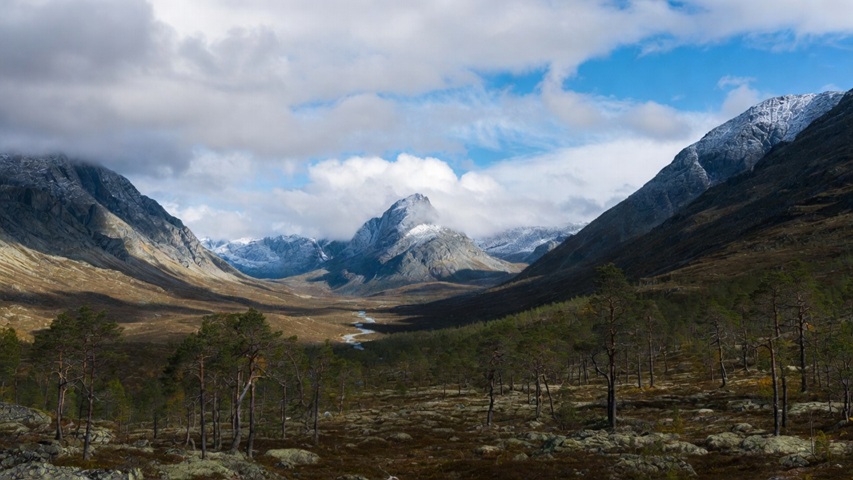
I arrived in the north expecting silence, but not this kind of silence. The kind that is not empty, but heavy. The kind that feels like it has been there long before you, and will remain long after you leave. Sarek is not a place that welcomes you in the traditional sense. There are no signs pointing the way, no paths guiding your steps, no cabins waiting with warmth and light. You step into it, and almost immediately you understand that this is not built for you at all.
Sarek National Park lies deep in Swedish Lapland, far above the Arctic Circle, and even on a map it looks distant. In reality, it feels even further removed, as if the act of reaching it is already part of the experience. It is one of Europe’s oldest national parks, established in the early twentieth century, but unlike most protected areas, it was never shaped to accommodate visitors. There are no marked trails guiding you through the terrain, no infrastructure designed to make the journey easier, and no real sense of direction once you are inside. What exists instead is a vast alpine wilderness that has remained largely untouched, where mountains, glaciers, rivers, and valleys exist entirely on their own terms.
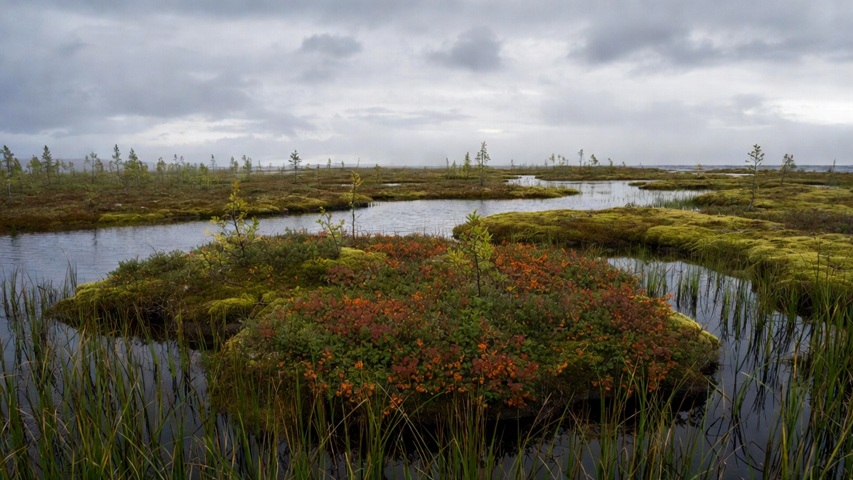
The scale of the landscape is something that only becomes clear when you are surrounded by it. Sarek is one of the most mountainous regions in Sweden, with peaks rising high above deep valleys that stretch endlessly across the horizon. Glaciers cut through the terrain, feeding rivers that move unpredictably through the land, sometimes spreading into wide, shifting deltas where water seems to take over everything. The Rapa Valley is often described as one of the most striking places in the park, where rivers branch out like veins, constantly reshaping the ground beneath them. It is a landscape that feels alive, not in a comforting way, but in a way that reminds you that everything here is in motion, driven by forces far beyond human control.
What sets Sarek apart from almost every other national park in Europe is not just its beauty, but its resistance. It does not offer itself easily, and it does not adapt to those who arrive unprepared. There are no roads leading into the park, no simple routes that carry you from one viewpoint to another, and often no obvious path forward at all. Even experienced hikers describe it as demanding, not only because of the terrain, but because of how quickly conditions can change. Rivers can become impassable within hours, weather shifts without warning, and distances that seem manageable on a map stretch into long, exhausting efforts on the ground.
It is often described as one of the last true wilderness areas in Europe, and that description feels accurate in a way that is difficult to overstate. In a world where most landscapes have been shaped, organized, and made accessible, Sarek remains largely indifferent to human presence. There is no attempt to make it more comfortable, no effort to create a sense of safety beyond what you bring with you. You are expected to adapt to it, to read it, and to respect it, rather than expecting it to meet you halfway.
At the same time, it would be wrong to think of Sarek as empty. This land has long been part of the life of the Sami people, whose connection to it stretches back generations. Reindeer move through the valleys, following patterns that have existed for centuries, and while their presence is not always visible, it is felt in the quiet understanding that this landscape has meaning beyond what a visitor might immediately see. It adds a layer of depth that goes beyond the visual, reminding you that wilderness is not always untouched, but often simply lived with in a different way.
Wildlife exists here in a way that feels entirely uncurated. There are no guarantees of sightings, no predictable encounters, and no sense that anything is arranged for observation. Large predators such as bears, lynx, and wolverines inhabit the area, along with birds of prey that move across the sky with a kind of effortless authority. But they are not there for you, and most of the time, you will not see them. What you feel instead is their presence, a quiet awareness that you are moving through a space that is not yours.
There is a particular kind of solitude in Sarek that goes beyond simply being alone. It is not defined by the absence of people, but by the absence of structure. Without trails, without clear destinations, and without the usual markers that guide movement, time begins to feel different. Progress is no longer measured in distance, but in effort, in terrain, and in how the landscape unfolds in front of you. Days lose their usual rhythm, becoming less about reaching a specific point and more about navigating something that does not particularly care whether you succeed or not.
That is also what makes it difficult. Sarek is not a place for beginners, and it does not pretend to be accessible. The lack of infrastructure means that once you are inside, you are largely on your own, often far from any form of assistance. Preparation is essential, but even with experience, there is an understanding that things can change in ways that are beyond your control. It requires a certain mindset, one that accepts uncertainty, discomfort, and the possibility that plans will need to be abandoned.
And yet, for those who are drawn to it, there is something deeply compelling about that rawness. In a world where so much is designed to be efficient, predictable, and easy to consume, Sarek offers something entirely different. It slows you down, forces you to pay attention, and removes the layers of convenience that usually separate you from the environment. What remains is something more immediate, more physical, and in many ways more honest.
That is why it stays with you. Not because it is easy, or even enjoyable in the way most destinations are, but because it feels real in a way that is increasingly rare. You do not leave with a sense of having completed something or checked it off a list. Instead, you leave with the feeling that you have briefly moved through a place that exists entirely on its own terms, and that your presence within it was only ever temporary.



What a truly amazing place, it’s a dream to go there someday!
I hope you get the chance! There is no place like it on earth!