There is a moment that almost every visitor to Sweden experiences sooner or later. You decide that a nice bottle of wine would go perfectly with dinner. You walk into the nearest supermarket expecting to find the familiar aisle of bottles that exists in most countries. Instead you find milk, bread, vegetables, maybe some low alcohol beer, and absolutely no wine. It feels like something must be missing.
In Sweden nothing is missing. You are simply looking in the wrong place.
Watch the video om Maria visiting Systembolaget
All stronger alcohol is sold through a government owned chain of stores called Systembolaget. If you want wine, whisky, vodka or anything stronger than light beer, this is the only place you can legally buy it. For visitors it often feels unusual, almost like stepping into a parallel retail universe where alcohol is treated not as a normal consumer product but as something that requires careful management.
The story of Systembolaget begins long before the modern Sweden that most people know today. In the late nineteenth and early twentieth centuries the country struggled with serious alcohol problems. Hard liquor was cheap and widely available and excessive drinking created major social issues. Reformers began arguing that limiting access to alcohol could reduce these problems. Over time Sweden introduced increasingly strict controls on alcohol sales, and in 1955 the current national monopoly was created by merging several regional systems into what became Systembolaget.

The principle behind it was simple. If profit driven companies compete to sell alcohol, they naturally want to sell more. A state run monopoly, on the other hand, has no incentive to increase consumption. The stores would exist to provide access to alcohol but without marketing, price competition or aggressive promotion. Alcohol would be available, but it would never be pushed.
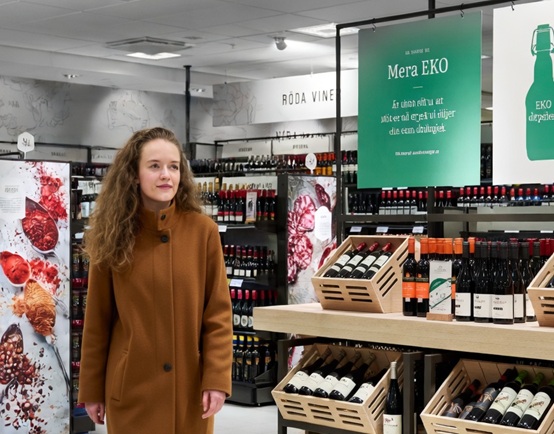
Walking into a Systembolaget today is a surprisingly calm experience. There are no flashing signs about discounts and no large displays encouraging customers to buy extra bottles. Everything is neat, quiet and orderly. Customers often browse slowly, reading labels or asking staff for recommendations. The atmosphere feels closer to a well organized library than a typical liquor store.
The staff play an important role in this experience. They are trained not only in responsible alcohol sales but also in wine and beverage knowledge. Many visitors are surprised to discover how helpful the employees can be. Ask for a wine to match a specific dish and they will often guide you to several thoughtful options. Despite being part of a state monopoly, the level of product knowledge is often higher than in many private alcohol stores around the world.
Find your nearest Systembolaget here…
Another surprise for many visitors is the quality and variety available. The selection at Systembolaget is enormous. Wines from small vineyards in Europe sit alongside bottles from South America, South Africa and Australia. Rare whiskies, craft beers from small breweries and specialty spirits from across the world all appear on the shelves. If a specific bottle is not available in your local store, it can often be ordered through the system and delivered to a nearby branch.
The rules surrounding opening hours, however, are where the system becomes most noticeable in everyday life. Systembolaget stores close earlier than many people expect. They are usually open during the day and into the early evening during weekdays, and on Saturdays they often close in the afternoon. On Sundays the stores remain closed entirely.
This schedule has created a familiar Swedish ritual. Someone suddenly realizes that wine might be nice for dinner and then checks the time. If it is close to closing time there can be a small rush of customers making their way quickly to the nearest store before the doors shut. For many Swedes the moment of discovering that Systembolaget closed ten minutes ago is a strangely universal life experience.
Despite these limitations, public support for the system remains relatively strong in Sweden. Surveys often show that many citizens believe the monopoly helps reduce alcohol related harm and keeps overall consumption lower than it might otherwise be. At the same time, debates about the system appear regularly in political discussions. Critics argue that modern Sweden could allow private competition while still maintaining responsible regulations, while supporters believe the monopoly continues to serve an important public health role.
For visitors the system can feel restrictive at first, but it also reveals something about Swedish society. The approach reflects a broader cultural tendency to balance personal freedom with collective responsibility. Alcohol is not banned or hidden away, but it is handled with a certain level of structure and caution.
Once you understand the logic behind Systembolaget the experience becomes easier to navigate. You plan your purchases a little earlier in the day, you learn where the nearest store is located, and you quickly discover that the selection is often better than expected.
The next time you find yourself standing in a Swedish supermarket wondering where the wine is, the answer is simple. It is not missing. It is just waiting for you at Systembolaget, along with a small piece of Sweden’s history and its uniquely organized approach to everyday life.